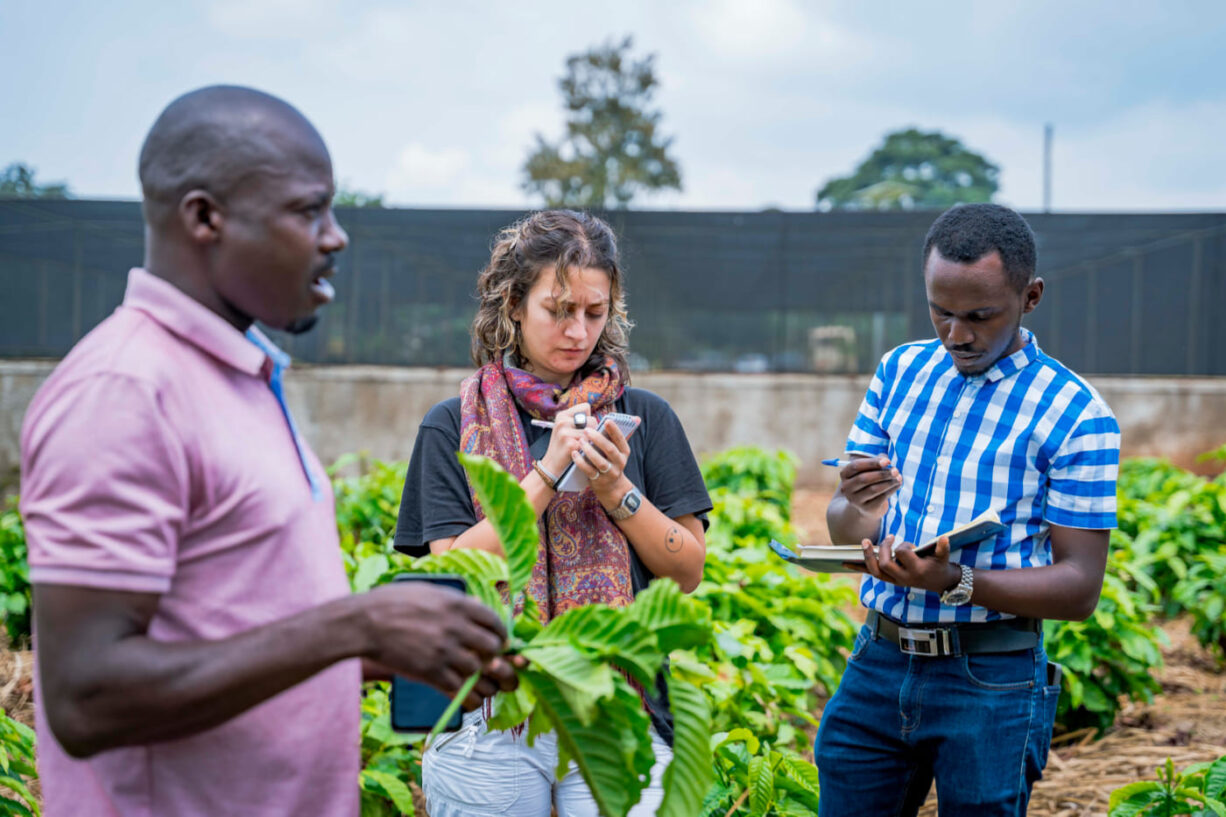
Five German-Ugandan Tandems for Sustainable Development
CoffeeXchange ran from May 2025 to March 2026 as part of the “Teams up! Youth exchanges for sustainable development” program line of the German-African Youth Office, funded by the Federal Ministry for Economic Cooperation and Development (BMZ). The focus was set on UN Sustainable Development Goal 8: Decent Work and Economic Growth. Participants on the Ugandan side included coffee farmers and cooperative managers, while the German side mainly consisted of agricultural students. Together, they formed five German-Ugandan tandems.
Practical Experience on Ugandan Coffee Farms
The face-to-face exchange was preceded by several digital workshops where participants got to know each other, formed their tandems, defined core topics for deeper exploration, and established guidelines for successful group and tandem collaboration.
In August 2025, the German group traveled to Uganda. Following a three-day welcome workshop focused on teambuilding and intercultural awareness, the centerpiece of the first encounter took place: a five-day internship on the farms of their Ugandan tandem partners—ranging from smallholder family farms to larger producer organizations. “It was incredibly fascinating to see how our colleagues manage their farms and with what passion they practice agriculture,” recalled one German participant.
An excursion lasting several days followed, visiting companies, cooperatives, and institutions to make further links in the Ugandan value chain tangible. The group visited the National Coffee Research Institute (NaCORI), which conducts research on cultivation and varieties; the umbrella organization NUCAFE, with a focus on processing and export; and the Kibinge Coffee Farmers’ Cooperative Society, where the value chain could be traced from the nursery through cultivation and processing to roasting and cupping. To conclude, participants reflected on and evaluated their stay and exchanged initial ideas for their joint business concepts within their tandems.
The Other Side of the Chain: Germany as a Coffee Hub
Between encounters, the tandems deepened their knowledge in a five-part webinar series with international experts—covering direct trade models, certification systems, EU regulations, financing, and climate-adapted coffee farming. The recordings are available on the Schorlemer Foundation’s YouTube channel.
During the second meeting in December 2025, the Ugandan participants explored the consumer side: visits to Fairtrade Germany, GEPA, the Mulembe Kaffee roasting house, and the Johann-Jacobs-Haus in Bremen, as well as short-term internships at specialty coffee roasters were on the agenda. A final networking workshop brought the group together with the Ugandan Embassy and key players from the German coffee sector. Throughout these sessions, an uncomfortable question repeatedly arose: Why does only a fraction of the final retail price of coffee usually reach those who cultivate it? Participants openly discussed trade structures, certification systems, and the historically grown power imbalances in the coffee trade while searching for ways to enable greater participation for producers.
Concrete Results—and Initial Business Relationships
In the follow-up phase, each tandem developed a dedicated business concept tailored specifically to the development goals of the respective Ugandan farm: ranging from identifying what the farm needs for its next growth step to tangible approaches for marketing and cooperation. At the final event on March 26, 2026, the tandems presented their concepts.
The example of Ugandan participant Joel Muwonge shows that the program has an impact beyond theoretical concepts: through CoffeeXchange, he connected with representatives of German roasters who have since visited his coffee farm. This was precisely the goal of the project: not only to impart knowledge, but to foster genuine connections between producers and buyers.
Outlook: CoffeeVoices
The approach continues: From August 2026 to July 2027, the Schorlemer Foundation will carry out the follow-up project CoffeeVoices. This time, it will be conducted together with the Tanzanian organization UCDP—a long-standing, reliable partner of the foundation in international intern exchanges—focusing on sustainable consumption. In German-Tanzanian tandems, short documentary films about the lives of coffee producers will be created. In Germany, participants will present these “Coffee Stories” at universities, trade fairs, and events—accompanied by tastings of a dedicated “project coffee.” In this way, abstract global supply chains will become tangible for consumers.
The initiative continues: From August 2026 to July 2027, the Schorlemer Foundation will run the follow-up project CoffeeVoices with the Tanzanian organization UCDP, focusing on sustainable consumption through short documentaries and coffee tastings. Interested coffee sector actors can contact Johannes Leberer or visit www.schorlemer-stiftung.de.