Stronger Together: New Handbook for and about Farmers’ Organisations published

by Marieke Behrens

How are strong farmers’ organisations built? Which structures have proven effective, and how can organisations represent their members successfully? The new handbook Farmers’ Organisations, published by AHA and WFO, brings together international experience, practical tools and case studies for everyone working to strengthen and further develop farmers’ organisations.

Foto: Andreas Hermes Akademie / William Veder

How can farmers be organised effectively? What makes a farmers’ organisation strong, representative and sustainable? And why do some organisations succeed in representing their members effectively, while others struggle to fulfil their role?

These are the questions addressed in the new publication Farmers’ Organisations: A Handbook, published jointly by the Andreas Hermes Akademie (AHA) and the World Farmers’ Organisation (WFO). The handbook was officially launched in Berlin as part of the celebrations marking the 20th anniversary of AHA International.

Foto: Andreas Hermes Akademie / William Veder

Pooling knowledge, sharing experience

The idea for the book emerged several years ago from a simple observation: although farmers’ organisations (FOs) play a central role in agriculture, food security and rural development worldwide, there had so far been no practice-oriented publication that systematically brought together their nature, functions and success factors.

This observation was developed into a joint project by AHA and WFO. Over several years, experiences, case studies and perspectives from all parts of the world fed into the publication, drawing on the rich knowledge of farmers’ organisations across the globe.

From cooperatives to advocacy

The handbook highlights the diversity of farmers’ organisations, ranging from local cooperatives and producer groups to national farmers’ associations and international networks. It provides practical insights into topics such as leadership and governance, advocacy, economic services, financing, organisational development and member orientation. In doing so, the publication draws on experiences from Africa, Asia, Europe and Latin America.

At its core is the conviction that strong farmers’ organisations are essential if farmers are to represent their interests effectively, learn from one another and actively contribute to shaping agricultural and food systems.
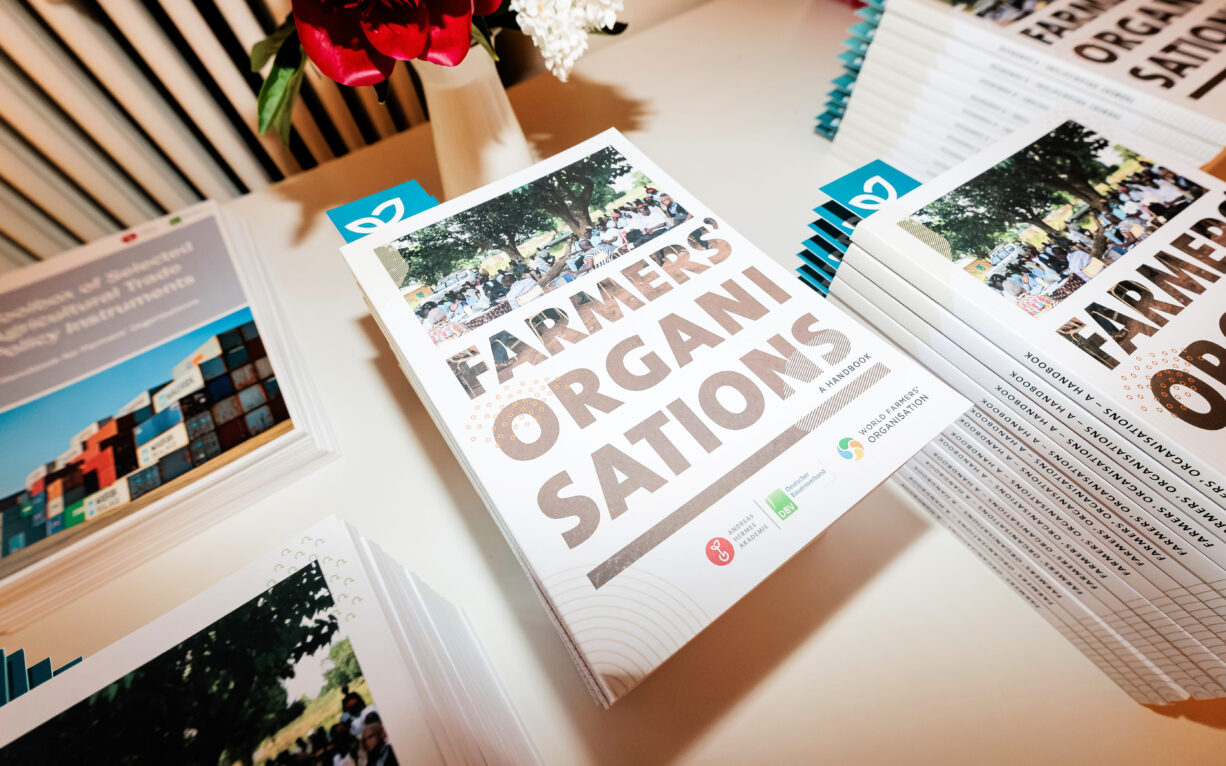
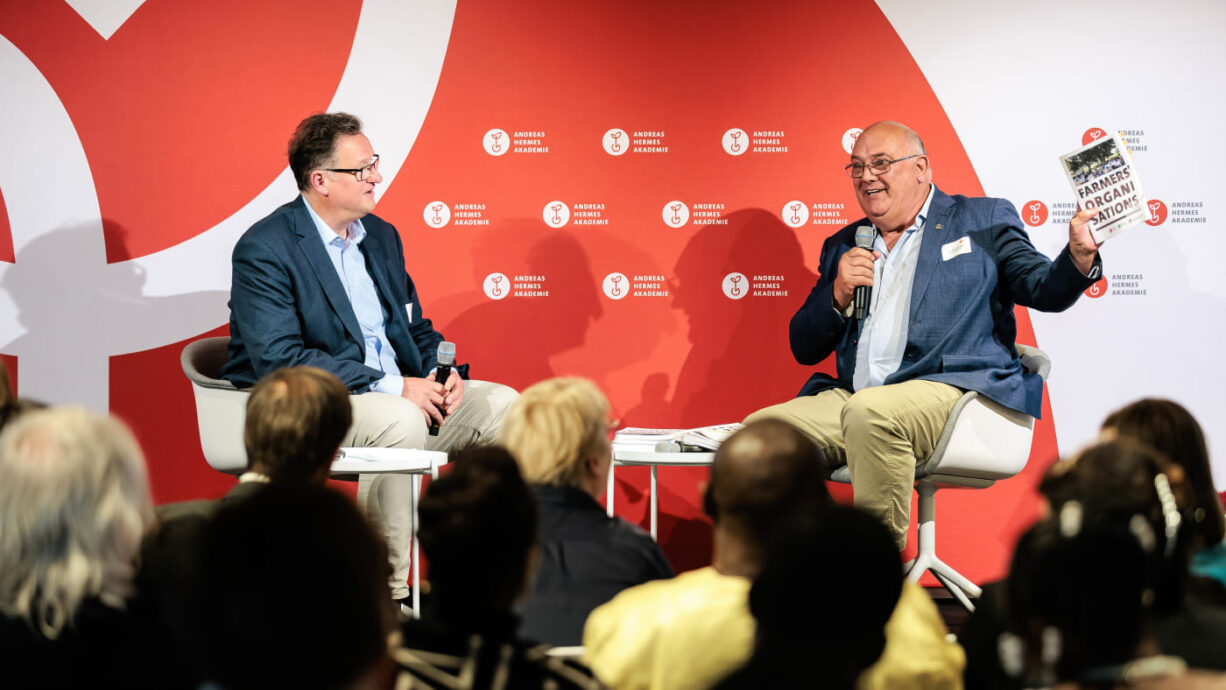
Foto: Andreas Hermes Akademie / William Veder

A book for practitioners

Unlike many academic publications, the handbook is deliberately aimed at people working in and with farmers’ organisations: voluntary leaders, staff members, advisors, policymakers and development organisations. It is intended as a reference work, a source of inspiration and a practical guide.

Its aim is to enable learning across organisational boundaries and to make experiences accessible that have already been gathered elsewhere. The book does not seek to prescribe universal solutions, but rather to offer ideas and approaches that can be adapted to local contexts.

The handbook was written by Dr Theo de Jager and Philipp Conze-Roos and published by the Andreas Hermes Akademie and the World Farmers’ Organisation with the support of the German Federal Ministry for Economic Cooperation and Development (BMZ).

Now available free of charge

The Author

Marieke Behrens

Programme Manager international